Elevating Digital Storytelling with the 3D Queue Pack
In the rapidly evolving landscape of digital design, the demand for assets that are both visually striking and conceptually clear has never been higher. As user interfaces become more immersive and marketing materials strive for greater engagement, flat vectors and stock photography often fall short of capturing the nuanced dynamics of modern life. This is where specialized collections like the 3D Queue Pack emerge as essential tools for creators. By focusing on a universal human experience—waiting in line—this collection offers a unique blend of relatability and high-end aesthetic appeal.
The concept of queuing is intrinsic to organized society. From purchasing tickets for public transportation to waiting for restroom access in busy venues, lines represent order, patience, and shared civic responsibility. However, depicting these scenarios in design can be challenging. Traditional illustrations may lack depth, while real-life photography can feel cluttered or impersonal. The 3D Queue Pack bridges this gap by providing meticulously crafted three-dimensional illustrations that bring structure and clarity to the concept of waiting. It is not merely a set of images; it is a curated resource for designers who need to communicate processes, flow, and public interaction with precision and style.
The Shift Toward Dimensional UI and Visual Communication
Over the past few years, there has been a noticeable shift in user interface (UI) and user experience (UX) design trends. While minimalism dominated the early 2010s, contemporary design is embracing depth, soft shadows, and tactile elements. This evolution, often referred to as "soft 3D" or "claymorphism," aims to make digital interactions feel more intuitive and friendly. Users are drawn to interfaces that mimic physical properties because they reduce cognitive load and enhance usability.
In this context, the 3D Queue Pack is perfectly timed. It allows designers to decorate their UI/UX projects with elements that feel tangible. Imagine a ticketing app for a metro system. Instead of using abstract icons, a designer can incorporate a subtle 3D illustration of people standing in an orderly line. This visual cue instantly communicates the function of the screen—managing entry or purchase—without requiring excessive text. The psychological impact is significant; 3D elements tend to hold attention longer and create a more memorable brand impression than flat counterparts.
Furthermore, this trend extends beyond apps. Websites dedicated to event management, logistics, or public services benefit immensely from such visuals. A queue website, for instance, can use these illustrations to reassure users that the virtual waiting room is organized and fair. The visual language of the 3D Queue Pack aligns with modern expectations for transparency and ease, making complex systems appear approachable.
Versatility Across Industries and Use Cases
One of the strongest attributes of this collection is its adaptability. The theme of queuing is not limited to a single industry. It is a cross-sector narrative that applies to retail, healthcare, transportation, entertainment, and public infrastructure. For marketers and business owners, having access to high-quality, thematic assets means faster turnaround times for campaigns and consistent branding across various touchpoints.
Consider the public transportation sector. Agencies constantly need to update signage, digital displays, and informational brochures. Illustrations from the 3D Queue Pack can be used to demonstrate proper boarding etiquette or to highlight designated waiting areas. Because the images are rendered in a clean, modern style, they remain legible and effective whether viewed on a large outdoor banner or a small mobile screen.
Similarly, in the realm of event planning and venue management, visual communication is key to crowd control. Posters indicating restroom queues or entry points benefit from clear, non-verbal cues. The 3D characters in this pack are designed to be neutral yet expressive, avoiding cultural specifics that might limit their applicability. This universality makes them ideal for international brands or multicultural environments where clarity transcends language barriers.
For freelancers and agencies, the ability to quickly deploy high-quality visuals is a competitive advantage. Instead of spending hours modeling scenes from scratch, designers can leverage the pre-rendered assets in the 3D Queue Pack. This efficiency allows them to focus on strategy and layout, ensuring that the final deliverable meets client deadlines without compromising on quality.
Technical Specifications and Workflow Integration
A design asset is only as useful as its compatibility with existing workflows. Professionals require files that are easy to edit, scale, and integrate into their preferred software. The 3D Queue Pack addresses these technical needs comprehensively, offering a robust suite of file formats that cater to different stages of the design process.
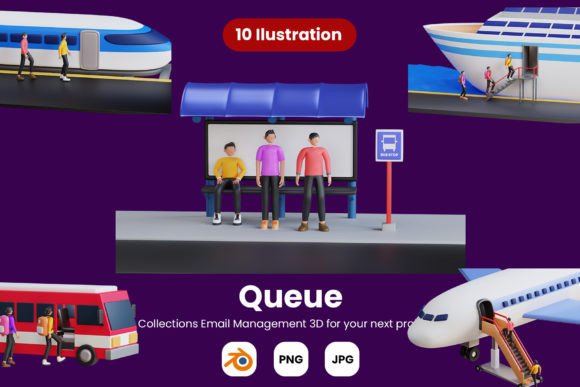
The package includes ten distinct 3D Blender files. For designers who work directly in 3D environments, this is invaluable. It allows for complete customization. You can adjust lighting, change camera angles, or modify textures to match your specific project requirements. This level of control ensures that the illustrations do not look like generic stock images but rather like bespoke components of your design system.
For those who prefer working in 2D environments, the pack provides ten high-resolution JPGs and ten PNGs. The PNG files are particularly useful for UI/UX design because they support transparency. This means you can layer the queue illustrations over various backgrounds, colors, or interface elements without worrying about unsightly white boxes or awkward cropping. The resolution of these images is 3000x2000 pixels, which is more than sufficient for high-density displays and print materials.
Compatibility is another critical factor. The files are optimized for use with industry-standard software including Adobe Photoshop, Adobe Illustrator, and Blender. Whether you are compositing a complex poster in Photoshop, creating vector-based layouts in Illustrator, or rendering scenes in Blender, the 3D Queue Pack integrates seamlessly. This flexibility reduces friction in the creative process, allowing teams to collaborate effectively regardless of their preferred tools.
- 10 3D Blender Files: Full source files for maximum customization and rendering control.
- 10 High-Resolution JPGs: Ideal for quick previews, presentations, and web backgrounds.
- 10 Transparent PNGs: Perfect for layering in UI designs, banners, and composite images.
- Resolution: 3000x2000 pixels, ensuring crisp details for both screen and print.
- Software Compatibility: Fully supported in Adobe Photoshop, Illustrator, and Blender.
Enhancing Brand Perception Through Quality Assets
In today’s market, consumers associate visual quality with brand reliability. Sloppy or outdated graphics can undermine trust, while polished, professional designs reinforce credibility. Using a specialized collection like the 3D Queue Pack signals that a brand pays attention to detail. It suggests that the organization values user experience and is willing to invest in clear, effective communication.
For entrepreneurs and small business owners, this is particularly relevant. You may not have the budget for a custom 3D animation studio, but you can still achieve a premium look by leveraging high-quality pre-made assets. The 3D Queue Pack democratizes access to advanced visual styles, allowing smaller entities to compete with larger corporations in terms of visual presentation.
Moreover, the emotional tone of 3D illustrations is generally warmer and more inviting than stark photography. In situations involving waiting or crowds, which can often be sources of stress for users, a friendly 3D illustration can help alleviate tension. It humanizes the process, reminding users that they are part of a structured, manageable system. This subtle psychological benefit can improve customer satisfaction and reduce perceived wait times.
Practical Recommendations for Designers
To get the most out of the 3D Queue Pack, consider the context in which you are deploying these assets. If you are designing a mobile app, use the PNG files to create lightweight, fast-loading interfaces. Ensure that the scale of the characters matches the rest of your iconography to maintain visual harmony. For print materials like posters or banners, utilize the high-resolution JPGs or render directly from the Blender files to achieve the highest possible fidelity.
Experiment with composition. Do not simply place the queue illustration in the center of the frame. Use it to guide the viewer’s eye toward a call-to-action button or important information. The directional nature of a queue naturally leads the eye forward, making it an excellent tool for establishing visual hierarchy. You can also combine multiple elements from the pack to create dynamic scenes that tell a story, such as showing the progression from entering a line to reaching the service point.
Finally, stay updated on how 3D trends evolve. While the current preference is for soft, friendly renders, styles may shift toward more realistic or abstract interpretations in the future. The foundational skills you develop by working with these files will remain relevant, but keeping an eye on emerging aesthetics will help you keep your designs fresh and engaging.
In conclusion, the 3D Queue Pack is more than just a collection of images; it is a strategic resource for modern designers. It addresses the growing need for dimensional, empathetic, and clear visual communication in a world that is increasingly digital yet deeply human. By integrating these assets into your workflow, you can enhance the usability of your interfaces, the impact of your marketing materials, and the overall perception of your brand. Whether you are building a queue website, designing a transit app, or creating informational posters, this pack provides the versatility and quality needed to succeed in today’s competitive creative landscape.